WaterFurnace Series 7 — Symphony Platform Analysis
🔧 Basement Unit — S/N *****833 Compressor replaced 2026-05-11
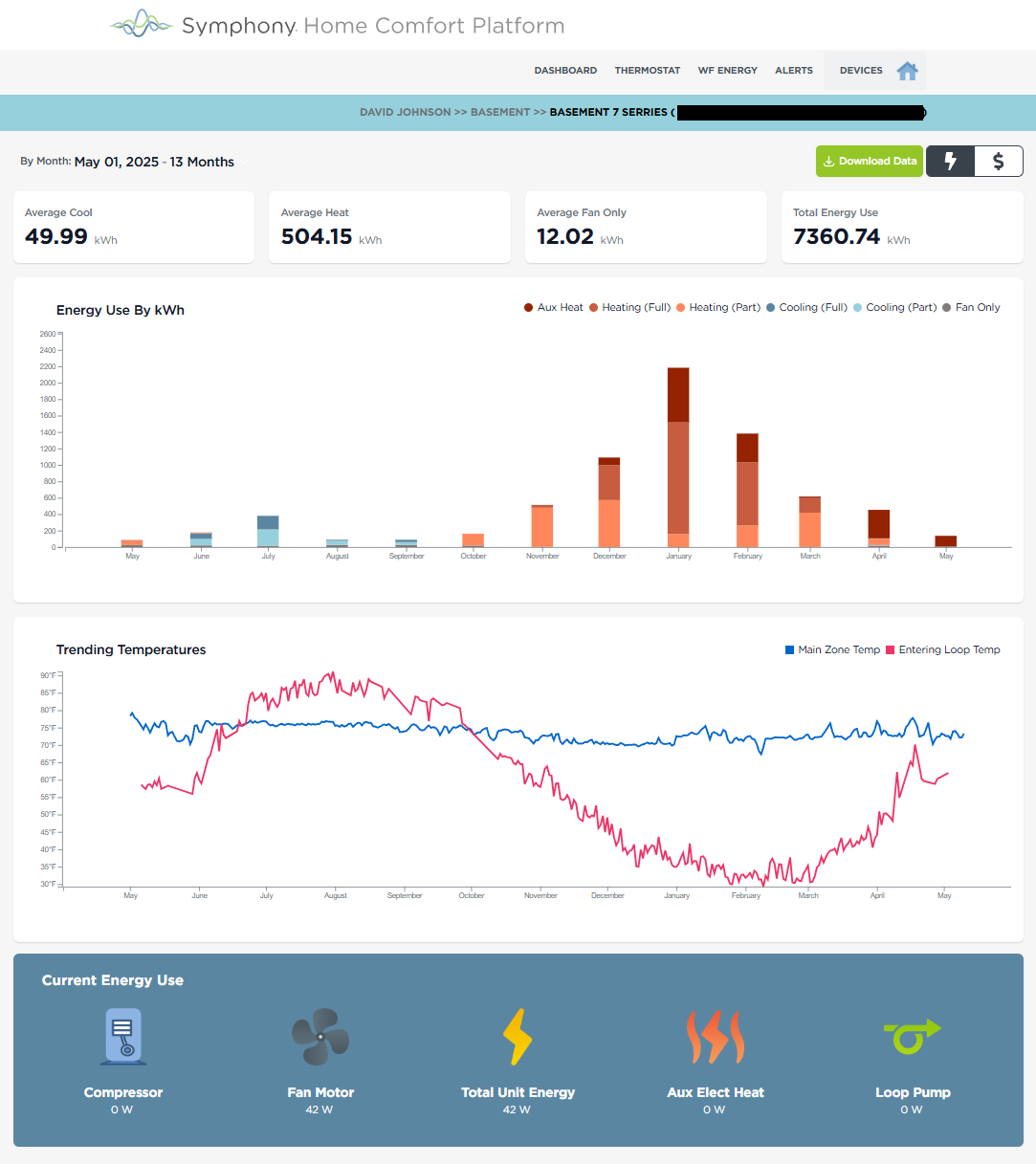
Symphony Dashboard — Basement Unit
✓ Attic Unit — S/N *****834
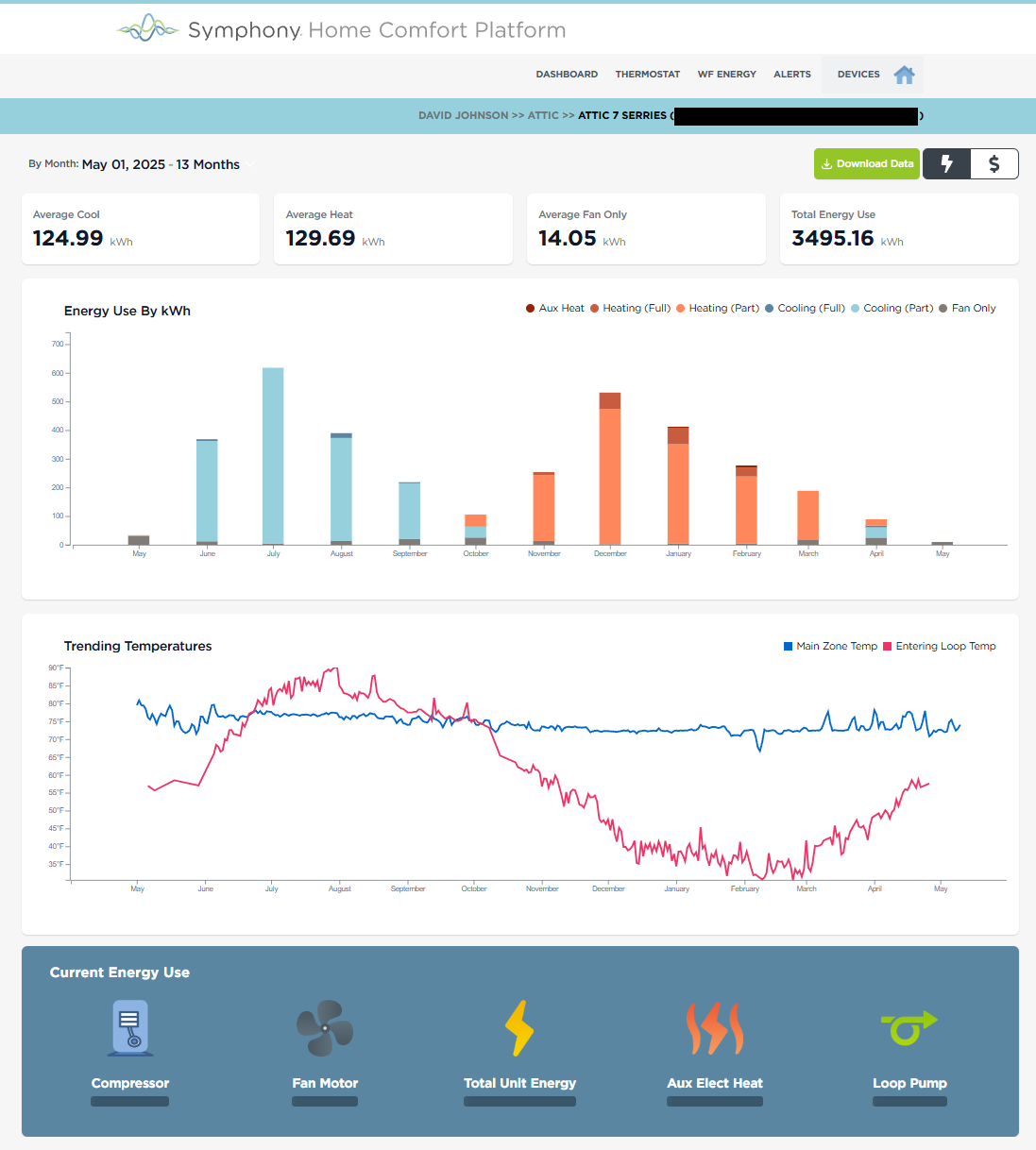
Symphony Dashboard — Attic Unit
WaterFurnace Series 7 — Technology Overview
The NVV036A111CTR0KN is a 3-ton (36,000 BTU/hr nominal) water-to-air ground source heat pump in WaterFurnace's 7 Series line. The Series 7 introduced variable-speed inverter-driven compressor technology — the same fundamental advance that made modern air-source heat pumps so efficient — to ground-source systems. Unlike earlier WaterFurnace models (5 Series, Envision) with single-speed or two-speed compressors, the Series 7 modulates from approximately 30% to 100% capacity, matching the actual heating or cooling load rather than cycling on and off. This produces superior comfort (no temperature swings), better dehumidification in cooling mode, and measurable COP improvements — WaterFurnace rates the 7 Series at up to 5.3 COP heating / 41 EER cooling under ARI 870 conditions.
The Aurora control system manages the inverter drive, monitors up to 20+ fault parameters in real time, and communicates with the IntelliZone2 zone controller and the Symphony cloud platform over Wi-Fi. This monitoring capability is what makes fault diagnosis possible remotely — every E-code, temperature reading, and power draw is logged and accessible through the Symphony web interface.
Symphony Monthly Legend
Basement Unit — Monthly Energy by Mode (kWh)
Attic Unit — Monthly Energy by Mode (kWh)
Both Units — Total Monthly kWh Comparison
Basement — Aux Heat Fraction by Month
Instantaneous Power Draw — Side-by-Side Comparison (Snapshot May 11, 4:57–4:58 AM)
Loop Temperature — The Compressor's Operating Environment
The entering water temperature (EWT) to the heat pump — the temperature of the fluid returning from the ground loop — is the single most important variable in a GSHP's operating environment. It determines the pressure ratio the compressor must work against: in heating mode, a colder EWT means the refrigerant low-side pressure is lower, the pressure differential is higher, and the compressor works harder. WaterFurnace Series 7 units are rated to operate down to 25°F EWT in heating mode, but efficiency and capacity drop significantly below 35°F EWT — and at those low entering temperatures, the Aurora controller may engage aux lockout protection.
From the Symphony trending temperature charts, the basement unit's entering loop temperature (pink line) drops to approximately 30–32°F in January 2026 — essentially at the Aurora freeze protection threshold (E58 triggers at 30°F leaving water temp) and well below the 35°F EWT below which efficiency drops sharply. This is not just the low end of the operating window; it is near the absolute minimum. A healthy compressor might survive here; a degrading inverter compressor encountering these loop temperatures triggered the low-pressure lockout cascade that became E56. The thermal context and the compressor degradation were mutually reinforcing failure modes.
Basement — Zone & Loop Temperature Trend (Reconstructed from Symphony)
Attic — Zone & Loop Temperature Trend
WaterFurnace Series 7 — Entering Water Temperature vs Efficiency
Loop Performance Checks — What to Ask Your Installer
| Parameter | Target / Normal Range | At or Near Fault Condition | How to Check |
|---|---|---|---|
| Entering water temp (EWT) — heating | 35–55°F for efficient operation | <30°F = compressor risk; <25°F = Aurora lockout | Symphony trending chart; Tech reads from service port |
| Leaving water temp (LWT) — heating | EWT minus 5–8°F (water gives up heat to refrigerant) | ΔT <3°F = low flow; ΔT >10°F = flow restriction | Inlet/outlet temperature probes at unit |
| Loop flow rate | 2.5–3.5 GPM per ton → 7.5–10.5 GPM for 3-ton unit | <2 GPM/ton = efficiency loss; circulator fault | Flow meter on loop; pressure drop calculation |
| Antifreeze concentration | 20–25% propylene glycol (freeze protection to ~15°F) | <15% = freezing risk if EWT drops below 28°F | Refractometer test on loop fluid sample |
| Loop pressure (closed loop) | 50–75 PSI at loop temperature | <30 PSI = air in loop or leak; >100 PSI = expansion issue | Service port pressure gauge |
| Water quality / pH | pH 7.5–9.0; inhibitor package present | <7.0 = corrosive; scale or biofilm buildup | Water sample to loop chemical analysis lab |
E56 — Fault Code Interpretation on WaterFurnace Series 7 / Aurora Controller
The WaterFurnace Series 7 uses the Aurora Advanced Control system. Aurora fault codes in the E5x range relate to refrigerant circuit protection. E56 specifically is a "Low Pressure Fault — Lockout": the Aurora controller has detected the refrigerant suction (low-side) pressure dropping below the low-pressure cutout (LPCO) threshold, tripped the compressor, and after multiple repeated events within a defined window, has entered a lockout state that requires manual reset or a wait period before allowing restart.
The Aurora controller monitors refrigerant low-side pressure continuously. A single LP trip (without lockout) produces an alert. When the fault occurs more than 3 times within approximately 8 hours, Aurora escalates to a lockout and logs E56. This trip-then-lockout pattern is exactly what a degrading variable-speed compressor produces: it runs, pressure drops, trips, resets, runs again, trips again — until Aurora stops allowing it.
What Causes Low Pressure (E56) on a Series 7?
| Root Cause | Mechanism | Probability (this case) |
|---|---|---|
| Refrigerant leak | Loss of R-410A charge → lower suction pressure → LPCO trips. Usually shows as gradual efficiency decline before lockout. | Moderate — but leak would not require compressor replacement, only recharge + leak repair |
| Failing inverter compressor | Variable-speed compressors rely on precise inverter drive control. Internal valve wear, winding degradation, or bearing failure causes inefficient compression → low suction pressure under load. | High — confirmed by compressor replacement |
| TXV (expansion valve) restriction or failure | A partially stuck-closed TXV starves the evaporator of refrigerant → suction pressure drops → LPCO trips. Can mimic compressor failure on diagnostics. | Moderate — TXV should be checked/replaced during compressor R&R |
| Extremely low entering water temperature | At EWT below 30°F, refrigerant operating pressures drop naturally. An otherwise marginal compressor that was holding at 35°F EWT may trip at 30°F EWT. Low loop temps can trigger LP faults even on healthy compressors. | Contributing factor — EWT was near 32–35°F in January |
| Low loop flow rate | If loop circulation is reduced (failing circulator, air in loop, fouled strainer), the fluid can't pick up heat fast enough → EWT drops further → lower refrigerant pressure → LPCO. | Possible contributing factor — loop pump at 198W is reasonable but verify flow rate |
Timeline of Compressor Degradation — What the Energy Data Shows
Aurora Fault Code Reference — E5x Refrigerant Circuit Faults
| Code | Name | Condition | Reset |
|---|---|---|---|
| E51 | High Pressure Fault | Discharge pressure exceeds HPCO set point (~590 PSI R-410A). Indicates: high loop temp (cooling), dirty air coil, refrigerant overcharge. | Auto after cool-down; lockout after 3× in 8 hrs |
| E52 | Low Pressure Fault (alert) | Single LP trip — suction pressure below cutout. Non-lockout alert. | Auto restart after short delay |
| E56 | Low Pressure Lockout | 3+ LP trips within ~8 hours. System locked out — compressor will not restart without intervention. This is the fault in your basement unit. | Manual reset at Aurora controller or thermostat; auto after 2-hour lockout in some firmware versions |
| E57 | Low Pressure Soft Lockout | LP trip count accumulated over 24 hours. Less severe than E56. | Auto after defined period |
| E58 | Freeze Fault | Leaving water temperature below 30°F (anti-freeze protection). Compressor and loop pump shut down. | Auto after fluid temp rises; check antifreeze |
| E59 | High Discharge Temp | Discharge line temperature exceeds limit (~260°F). Indicates: low refrigerant, TXV stuck open, compressor valve failure. | Auto after cool-down; lockout after 3× |
⚠ Post-Compressor Replacement — What to Watch For
A compressor replacement on a variable-speed GSHP is a major refrigerant-system service event. The quality of the replacement installation matters enormously — a poorly executed R&R can produce a new compressor that fails faster than the original. Key concerns in the first 90 days after replacement are refrigerant charge integrity, oil management, filter/drier replacement, TXV function, and — as your current Symphony data suggests — verifying the system is not over-relying on aux heat.
Immediate Post-Installation Verification (Weeks 1–2)
-
Refrigerant charge verification: Technician must verify superheat and subcooling with gauges after replacement. R-410A charge on a 3-ton unit is typically 6–8 lbs. Under- or over-charge by even 10% significantly reduces efficiency and strains the new compressor. Do not skip this step — confirm it was performed.
-
Filter/drier replacement: The filter-drier must always be replaced during a compressor change-out. The old drier absorbs moisture and contaminants over its lifetime — reusing it risks contaminating the new compressor with acids and debris from the failed unit. Confirm with your installer.
-
System flush / acid neutralisation: A failed compressor often releases acid and metallic debris into the refrigerant circuit. A proper R&R includes flushing the refrigerant circuit and verifying acid neutraliser (if not flushed). Ask your technician whether a refrigerant circuit acid test was performed.
-
TXV inspection: If the TXV (thermostatic expansion valve) was not replaced during the compressor R&R, and the old compressor was contaminating the system, the TXV may be partially fouled. A stuck-open or stuck-closed TXV will cause the new compressor to run inefficiently and may generate new LP faults.
-
Aurora fault history reset: After replacement, the Aurora controller should have its fault history reviewed and potentially cleared. Any pre-existing fault counters should be reset so new post-replacement faults are correctly attributed. Confirm the technician did this.
-
Investigate the current aux heat situation: Your Symphony snapshot shows the basement unit drawing 7,769 W of aux heat at 4:57 AM on May 11. On a recently replaced compressor in May, this is abnormal. Either the refrigerant charge is low, the system is in emergency heat mode, or there is a thermostat/control configuration issue. Call your service provider and share the Symphony screenshot.
30–90 Day Monitoring Period
-
Monitor aux heat hours on Symphony: Use the monthly energy chart to confirm the aux heat fraction is declining from the pre-replacement elevated pattern. By May–September, aux heat should be near zero on the basement unit during normal operation. Any recurrence of elevated aux heat is a flag.
-
Watch for E56 recurrence: If E56 returns within 90 days, the replacement may have an issue: under-charged refrigerant, faulty TXV, loop flow restriction, or — in a worst case — another compressor defect. WaterFurnace compressors have a 10-year warranty (with registration); a premature failure should be a warranty claim.
-
Listen for compressor sounds: A new compressor should be quiet and smooth. Warning sounds include: liquid slugging (gurgling at startup — indicates liquid refrigerant or oil flooding the compressor on startup, common if the unit sat idle post-replacement), grinding or rattling (bearing issues), and hissing (refrigerant leak).
-
Crankcase heater verification: The Series 7 has an electric crankcase heater that runs when the compressor is off to prevent refrigerant migration into the oil. After replacement, confirm the crankcase heater is energised (warm to touch at the base of the compressor) — if the heater is not functioning, the compressor can be damaged on first startup from liquid slugging.
-
Compare to attic unit baseline: Use Symphony to compare monthly kWh and aux heat fraction between your basement and attic units. After a successful replacement, the basement unit's aux heat fraction should converge toward the attic unit's pattern. If basement aux remains 2–3× the attic unit's level, the system still has a problem.
-
Next heating season preparation: Schedule a loop system service before October — verify antifreeze concentration, loop pressure, and flow rate before the next heating season stresses the new compressor with cold entering water temperatures.
Post-Replacement: Expected Performance Recovery
Questions to Ask Your Service Technician
| # | Question | Why It Matters |
|---|---|---|
| 1 | Was the filter-drier replaced during the compressor swap? | Must be replaced every time — non-negotiable |
| 2 | What were the superheat and subcooling readings after recharge? | Confirms correct refrigerant charge; ask for the numbers on the service ticket |
| 3 | Was a refrigerant acid test performed? | Failed compressors contaminate the circuit; acid left behind damages new compressor |
| 4 | Was the TXV inspected or replaced? | TXV failure is a frequent companion to compressor failure; if not checked, new E56 faults are likely |
| 5 | Is the crankcase heater operational? | Protects the new compressor from liquid slugging on startup |
| 6 | Was the Aurora fault history reviewed and reset? | Pre-existing fault counters should not carry over to post-replacement operation |
| 7 | Why is the basement unit showing 7,769 W of aux heat at 4:57 AM on May 11? | This is your immediate concern — show them the Symphony screenshot |
| 8 | What was the measured loop flow rate, and is it within spec (≥2.5 GPM/ton)? | Low flow contributed to or caused the LP faults; must be verified post-replacement |
| 9 | Was the compressor replaced under warranty? If not, why not? | Series 7 compressors carry a 10-year parts warranty if registered |
| 10 | What is the antifreeze concentration and loop pH? | Low antifreeze = freeze risk; poor pH = corrosion and future loop issues |
COP Analysis — Estimated Performance by Season
Annual Energy Cost Breakdown — Both Units
Optimization Recommendations — Series 7 System
| Action | Expected Benefit | Priority |
|---|---|---|
| Resolve basement aux heat issue (see Post-Replacement tab) | Reduce aux heat from ~73% of draw to <10% in mild weather; estimated saving: $80–150/yr | Immediate |
| Verify loop antifreeze & flow rate | Raising EWT by 3–5°F through proper flow improves COP by ~0.3–0.5; reduces LP fault risk next winter | Before next heating season |
| Symphony alert configuration | Set up email/push alerts for any E-code fault so you catch recurrence immediately rather than after repeated lockouts | This week |
| Thermostat setback optimisation | Variable-speed GSHPs are more efficient running at steady lower output than recovering from deep setback — large setbacks force high-capacity operation and aux heat engagement on recovery | Review settings |
| Desuperheater check (if equipped) | If your units have desuperheater (domestic hot water preheat) — verify it is operational; free hot water generation from compressor waste heat is particularly valuable in heating mode | Service call |
| IntelliZone2 load balancing | If both units share a loop field, verify IntelliZone2 is not running both units simultaneously in heating mode — compounding loop temperature draw | Verify with installer |
| Annual loop system service | Antifreeze concentration, pH buffer recharge, loop pressure check, strainer cleaning — prevents the slow loop degradation that contributed to compressor stress | Annual — October |
| Air filter maintenance (both units) | A clogged air filter on a variable-speed unit restricts airflow, raises discharge temperature, and can trigger E59 faults. Series 7 needs filter checks every 30–60 days in heating season. | Monthly check |
Service & Maintenance History
Documented service events for both units. Use this as a reference when correlating Live Monitor data with known maintenance milestones.
Basement Unit · S/N *****833
| Date | Invoice | Technician | Work Performed | Total |
|---|---|---|---|---|
| 2026-05-11 | Inv #**** | Local HVAC technician |
Compressor Replacement — Fault code diagnosed on first visit.
Drive board and compressor ordered. Returned 5-11-26: installed new compressor (#34P649-01)
and filter drier (7/8"), recharged with 6 lbs R-410A, purged system and tested for leaks,
verified relief valve on system.
Compressor #34P649-01
Filter Drier 7/8"
6 lb R-410A
Drive Board
|
Mat: $500
Labor: $770
$1,370
|
Attic Unit · S/N *****834
| Date | Invoice | Technician | Work Performed | Total |
|---|---|---|---|---|
| No service events recorded. | ||||
Parts & Case Reference
| Item | Part / Case # | Unit | Date | Notes |
|---|---|---|---|---|
| Compressor | 34P649-01 | Basement | 2026-05-11 | Replacement unit, E56 fault |
| Drive / Control Board | PP…60-04 | Basement | 2026-05-11 | Ordered alongside compressor; installed same visit |
| Filter Drier | 7/8" (std) | Basement | 2026-05-11 | Replaced with compressor |
| Refrigerant | R-410A | Basement | 2026-05-11 | 6 lbs added after compressor swap |
| WF Case | 17PS**-** | Basement | 2026-05-11 | WaterFurnace factory case reference — verify warranty claim status |
Warranty Coverage
| Unit | Model | S/N | Install | Compressor warranty | Parts warranty | Heat exchanger |
|---|---|---|---|---|---|---|
| Basement | NVV036A111CTR0KN |
*****833 | 2017 | 10 yr → ~2027 | 10 yr → ~2027 | Lifetime |
| Attic | NVV036A111CTR0KN |
*****834 | 2017 | 10 yr → ~2027 | 10 yr → ~2027 | Lifetime |
WF case number
17PS**-** on the invoice indicates WaterFurnace opened a factory case for this repair.
Confirm with WaterFurnace (1-888-592-9436) whether the $500 materials charge was processed as a warranty claim
or billed directly. If the latter, you may be owed reimbursement for the compressor and drive board.